Reworked & Reimagined
The two blank spots on the dust wall, deserted by two grandmasters, will receive special attention during the restoration of the church from students of the Royal Academy of Fine Arts in Antwerp.
The students Visual Arts reinterpret The Flagellation and The Carrying of the Cross. After finishing, you will discover their works on canvas, on paper or on panel among the other ’13 Mysteries’ on the dust wall or in the cloister.
The students of the In Situ program tackle the wide range of impressions and atmospheres that the Sint-Pauluskerk has to offer. Who are they? What drives them? What is the story behind their artwork? Discover it here.
Daan Van Nunen (B) - Some might say they fell off a truck (in situ/ended)
Daan van Nunen (born 2000), born in Beveren, Belgium, is an art student at the Royal Academy of Fine Arts Antwerp. Daan is interested in human behavior and social conditioning. He draws inspiration from encounters and institutions, attempting to recreate and amplify these experiences until they border on the absurd.
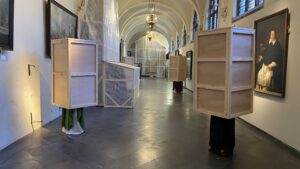
“A church is like a chest: it contains something valuable, something precious, something that must be preserved. It protects something fragile, it covers and serves as a safe haven. Seeing a treasure chest, a transport crate, or a coffin evokes a sense of curiosity about its contents. Just as when you stand before a closed church, knowing it overflows with magnificent scenes.
When you are in a church, the outside world stands still. You are closed off and surrounded by stories of suffering and hardship. A suffocating overwhelm takes over, almost claustrophobic, as if you are in a confined space: a coffin.”
This sense of isolation and vulnerability forms the core of the work presented in St. Paul’s. Seven coffins have been distributed in a cloister, allowing visitors to move around the sculptures and experience them up close. Life-sized and supported by legs, as if someone were inside the coffin. Closed off from our world, yet still vulnerable because of their partial covering.
Paul Muller (GER) - Low Hanging Cloud (In Situ)
Paul Müller (born 1999) was born in Frankfurt am Main and grew up in Seligenstadt, an old city with a predominantly Baroque basilica and the birthplace of Hans Memling (born 1430). Memling later moved to Bruges, where he became one of the most important painters of the Netherlands.
Our Frankfurt native studied Photography and Spatial Arts at HfG Offenbach, Fine Arts at Chelsea College London, and completed his studies in 2022 with a Master’s degree from In Situ at the Royal Academy of Fine Arts Antwerp. Since 2023, he has taught at In Situ, where he is currently supervising a project of artistic research on art in public spaces.
His work has received awards, including the German Youth Photography Prize and the Artistic Award of the Horlait-Dapsens Foundation. It is primarily shown in group exhibitions or at festivals in project spaces and galleries in Germany, the United Kingdom, Belgium, and Luxembourg.
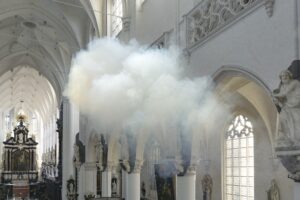
During the evening event on May 15th, Paul Müller’s installation went live in St. Paul’s Church, and it has been on display there daily ever since. Once a day, around 3:45 PM, mist is injected into the nave of St. Paul’s Church at a height of twenty meters. The mist transforms into a low-hanging cloud, reminiscent of the heavenly clouds in the church’s Baroque iconography. It hangs there for only a short time before dissipating.
Paul Muller writes:
“The heavenly cloud is a recurring motif in Baroque painting, including the prominent paintings of the Rosary cycle in St. Paul’s Church. As a bridge between heaven and earth, the cloud descends to our level. It never does so alone, but is accompanied by angels, putti, or the Holy Spirit. The cloud supports the Ascension of Christ and the Assumption of Mary. In Catholic liturgy, mist or smoke appears in the form of burned incense. When, as a child, I had a transcendental experience walking above the clouds
in the Swiss Alps, I became fascinated by clouds in their own landscape, which forms the boundary between earth and sky. We come closer to heaven when we let the clouds descend into the church, a symbol of our longing to be closer to heaven in this sacred space.”
Gabriel Siams (Br) - Madonna's Runway (in situ) (ended)
Gabriel Siams (born 1996, Rio de Janeiro, Brazil) is a transmedia artist whose work is shaped by his early experiences in religious settings, where he was exposed to the power of symbolism and its potential for subversion. This formative experience is central to his artistic practice, which explores the relationships constructed by ancient symbolism, some of which dates back to pre-Christian times and is still present in contemporary culture.
Siams also investigates the possibilities for transformation of materials, moments of transition, and states of indeterminacy; the in-between, the ambiguous, the malleable. Through installation, photography, moving image, performance, and sound, his practice takes various forms, between narrative and documentary, but without conforming to one form or the other.
Siams has exhibited at institutions such as De Singel, Culturgest, BoCA Biennale, and MAAT (Museum for Art, Architecture and Technology). His work is represented in public and private collections in South America and Europe.
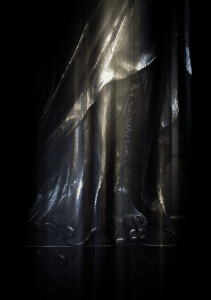
Madonna’s Runway is a sound installation featuring a repetitive sound of high heels that echoes throughout the interior of St. Paul’s Church. The work refers to the absence of feet in the sculptures of the confessionals—a deliberate choice, with the exception of the angels.
It is rumored that a local council of high clergy wanted a clear distinction between beatified and canonized figures in the sculpted figures. Angels, as messengers, needed wings and feet to move efficiently between heaven and earth. The saints were also given feet. However, the Dominican Blesseds—still Blesseds when the confessionals were sculpted, but now saints—were not given feet. The Dominicans therefore decided that no saint in the confessionals would have feet, only the angels.
William De Muynck (B) - The Flagellation, oil on canvas, painting and modello (Visual Arts)

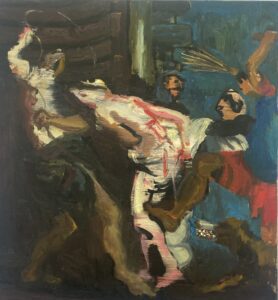
William de Muynck (born 2000) is a painter based in Antwerp. Raised in Italy, he is currently completing his studies at the Royal Academy of Fine Arts in Antwerp. He works primarily in oils. He often bases his works on mythological themes and moves between figuration and abstraction, focusing primarily on compositions with multiple figures. His work is characterized by emotional intensity and compositional experimentation.
De Muynck listened carefully to the message of the fifteen mysteries and subsequently carefully studied The Flagellation by Peter Paul Rubens. For his work, he adopted the core of Rubens’s painting, along with several striking details: Christ and the flagellar on the left, Christ’s pulled-away loincloth, and the whipping rope in the flagellar’s hand on the left. William De Muynck has transformed the dog into a formidable beast, making a mockery of the gentle shepherd dog in Rubens’s work.
He has incorporated these elements into a figurative abstract painting, in which the secondary figures, as in Rubens’s work, seem to move around Christ. The executioners and soldiers on the right are reduced to their brutality and ugliness. The writhing Christ, like in Rubens’s work, displays a severely bloodied back. The faint halo above Christ’s head in the Baroque master’s painting has been replaced by a radiant parody of a crown of thorns, as part of the impending mockery in the adjacent work in the series.
De Muynck has respectfully conveyed the essence of the scene in his work. The colors he uses emphasize the status of the figures on the canvas, from the bloodied and mocked Christ to the almost clownishly dressed executioners on the right.
Izabella Kawycz (Pl), The Carrying of the Cross (a second before), oil on canvas (Visual Arts) and studies


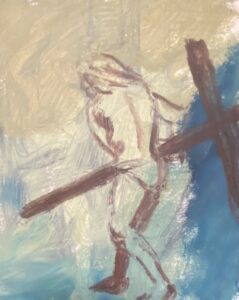

Izabella Kawycz (born 2004) is a young painter from Warsaw, Poland, who lives in Antwerp. She is a bachelor’s student at the Royal Academy of Fine Arts in Antwerp. Izabella primarily creates oil paintings, sometimes combined with other techniques. Her current works are mostly figurative. She works both from observation—making studies of nature—and with models. By combining these with imaginative compositions, her paintings create a certain distortion and surreal landscapes.
The artist often incorporates digital collages into her paintings. The primary subjects in her work are images of bodies interacting with the surrounding landscapes. More specific examples include recurring reflections and repetitions in the composition and an emphasis on movement. Izabella Kawycz strives to create paintings that offer a convincing sense of reality, yet leave the viewer with doubts.
Izabella Kawycz’s The Carrying of the Cross (a second earlier) takes us along the path of the tormented Christ. Disoriented, He is almost literally no longer of this world. The solar eclipse approaches, dark clouds gather over Golgotha. Christ stumbles through a desolate landscape. On the horizon, three unrecognizable figures shuffle—are they convicts, soldiers, executioners?
Izabella Kawycz shows what might have happened moments before Christ collapses under the cross, meets his mother, and Simon of Cyrene comes to his aid. From then on, Anthony Van Dyck takes over; Kawycz’s work is his The Carrying of the Cross, but just before.
Kawycz presents a raw version of the story. Christ is shown three times, from right to left. On the right, He is a stricken figure, struggling to hold himself upright. Then we see Him succumb in two phases; we can almost hear the groan of pain as we look at the middle figure. At the end He kneels and we think of what happens next in Van Dyck’s painting.
Christ’s disorientation in this painting is expressed in his walking direction. The figures in the background move upwards to the right. Christ appears to be walking in the wrong direction, even against the direction of the 15 Mysteries. Kawycz seems to have found inspiration in Van Dyck’s sketches for Christ Carrying the Cross, where the left-right orientation we know from the painting only emerged later in his creative process.
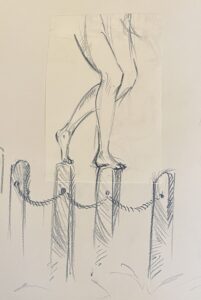
Eva Raczkowka (Pl), Tha Carrying of the Cross, studies (crayon/oil on cardboard)


Carl Kusters (B) - '01-02-03 after the Flagellation of Christ', acrylic on paper (painting)
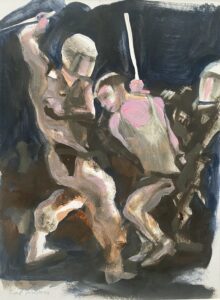


Carl Kusters (born in Schoten in 1954) studied decorative arts at the Academy of Bruges (1970-1973), graphic arts at Sint-Lucas in Schaarbeek (1973-1974), and graphic arts at the Academy of Ghent (1974-1977). His “01-02-03 after the Flagellation of Christ,” which can be seen today in St. Paul’s Church, was created in 2011-2012 during an art project organized by Wisper Ghent, MSK Ghent, and Kunstwerkt. Participating artists selected a work from the collection of the Museum of Fine Arts in Ghent to create their own interpretation.
For Carl, one of the works was the modello of Rubens’s Flagellation. This small oil painting on panel
(37.4 x 35.1 cm) was intended as a sketch for the fully developed, large-format original. Carl created three preliminary versions. He retained none of them. After the project, he created three new versions, placing the figures in a contemporary context.
In 2024, he participated in ‘Sant 2024’ in Bruges with these three works. Along with the works of 20 other candidates, he was selected to exhibit under the Hallen in the Hendrik Pickery Hall in Bruges. He didn’t win, but he was very pleased with his participation.
Yentl Proost (B), painted after 'the carrying of the cross', oil on canvas (painting)
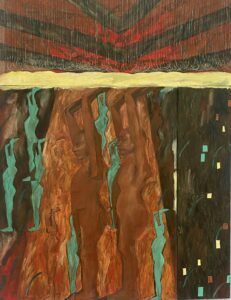
Yentl Proost (born 2003) studied textile design for the past three years. There, she discovered a love of craftsmanship and slow, deliberate work. In 2025, she began studying painting. She finds inspiration in everyday situations: motifs, shapes, and tensions, creating an abstract interpretation of the world through various materials and compositions. Therefore, you’ll often find handicraft and DIY elements in her work.
Before developing her interpretation of the Carrying of the Cross, Yentl reread this Bible story. The role of Simon of Cyrene, who helped Jesus carry the cross, resonated strongly with her. The weight becomes lighter when many lift together. Many hands make less work—that’s a timeless message.
In her preliminary studies, she primarily played with the figures: their number, size, and arrangement. She searched for a way to best depict this multitude of figures in a playful way. Despite the various sketches, she still ended up with a completely different composition, which came about during the painting process.


Kendall De Rue (B) - the Carryng of the Cross, oil on canvas, paper, 210 x 160 (painting)

Kendall De Rue is a Belgian artist based in Antwerp. He works on a project basis, combining conceptual thinking with a painterly plasticity. His practice explores the interplay between idea and material, often operating at the intersection of abstraction and form. He is currently completing his master’s degree at the Royal Academy of Fine Arts in Antwerp.
In this work, he examines the tension between classical portraiture and the mechanical reproduction of photography. Old portrait paintings form the framework within which old magazine portraits are integrated. This creates an anachronistic hybrid. Icons from a bygone era are incorporated into the visual language of an older world. The result is a new, fictional history. These hybrid portraits play a dual role between reality and construction, between memory and oblivion, between past and imagination. Classical poses and iconographic objects reinforce the layered nature of the image.
A key aspect is the tactile illusion. By seamlessly interweaving collage and paint, a confusion arises: from a distance, it appears to be an authentic historical painting, but up close, the surface betrays its dual nature. The smoothness of the photographic image subtly contrasts with the texture of the paint. The painting thus becomes a play between appearance and reality. In which not only the image, but also the material, lies.
Paradoxically, this ‘false reality’ conceals a deeper truth: an artificial reflection on how we view images, memories, and meaning. The work invites reflection on how we remember, forget, and how the image, even after death, continues to speak.
In this specific work, he starts from the Carrying of the Cross, but shifts the focus to the bystanders. Christ almost disappears into the crowd; it is the gazes and postures of the crowd that are central. Their indifference raises an uncomfortable question: how would we react today if we were face to face with the suffering of Christ?
others - drawings


newsletter
We send a weekly newsletter with activities and information from the Saint Paul’s community.